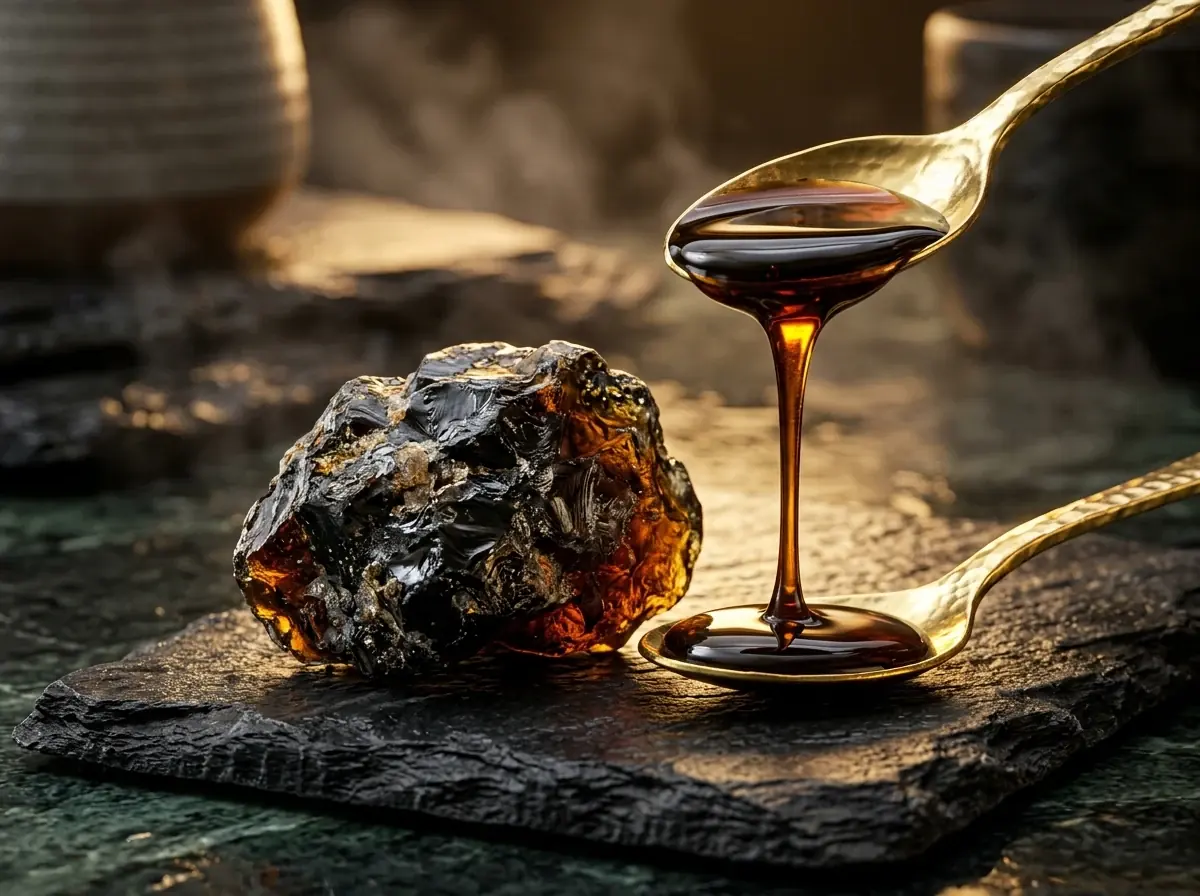
Salajeet is one of the most searched herbal products in Pakistan, and also one of the most misused. People take too much, take unpurified resin, or take it for months without a break. This guide covers the practical side: how much to take, when, with what, and in which form. For what salajeet is and how to spot a fake, read our complete salajeet guide.
How much salajeet should you take?
In Unani practice, purified salajeet resin is taken in very small amounts. The traditional measure is about the size of a grain of rice, up to the size of a chickpea. Clinical studies on purified shilajit extracts have used doses in the range of a few hundred milligrams per day, which is roughly the same small amount.
More is not better. Salajeet is concentrated, and larger amounts are more likely to cause stomach upset or a feeling of heat in the body, which Unani practice attributes to its hot and dry temperament (mizaj).
- Resin: start with a rice-grain amount. Your product label or hakeem may advise increasing slowly.
- Capsules: follow the label exactly. Capsule strength varies a lot between brands.
- Majoon: salajeet is one ingredient among several, so the dose is the majoon dose on the label, usually one teaspoon.
What is the best time to take salajeet?
Most people take salajeet in the morning, before or with breakfast. Its traditional role is as a strengthening tonic for the day ahead, and some people find it slightly energising, which is why a late-night dose can disturb sleep for a few.
If a hakeem advises two doses, the second is usually taken in the early evening rather than right before bed. Taking it at the same time each day matters more than the exact hour.
Should salajeet be taken with milk or water?
Both are traditional. Warm milk is the classical Unani carrier: it is thought to balance salajeet's heat and it softens the strong, bitter taste. Warm water works for people who avoid dairy or find milk heavy.
The liquid should be warm, not boiling. Stir until the resin dissolves completely. Purified salajeet dissolves in a few minutes and leaves little or no grit; if yours leaves sediment, see how to identify original salajeet.
| Carrier | Traditional reason | Best for |
|---|---|---|
| Warm milk | Classical choice; balances the hot temperament and the taste | Most people, especially in winter |
| Warm water | Simple and light | People who avoid dairy or feel heavy after milk |
| Honey in warm water | Used in some Unani recipes to improve taste | People who dislike the bitterness (not for diabetics) |
Resin, capsules or majoon: which form is best?
Each form has a real advantage, and the right choice depends on what matters most to you.
| Form | Advantages | Drawbacks |
|---|---|---|
| Resin | Least processed; easiest to test at home for purity | Strong taste; dose is measured by eye |
| Capsules | No taste; exact dose | Hard to verify what is inside; quality varies widely |
| Majoon | Combined with complementary herbs such as saffron and asgandh in a classical formula; pleasant taste | Contains honey or sugar; less salajeet per dose |
If you want salajeet on its own, resin gives you the most control. If you prefer a traditional compound formula, a majoon such as our Majoon Zafran & Salajeet combines it with saffron and other classical ingredients.
How long should you take salajeet?
Unani practice uses salajeet as a course, not a permanent daily habit. A common pattern is several weeks of use followed by a break of similar length. The clinical studies published so far ran for about 90 days, and there is little research on continuous use beyond that.
Keep your expectations realistic. Salajeet is a traditional tonic, not a medicine, and any effect builds gradually. If you notice no difference after a full course, continuing indefinitely is unlikely to help.
Common mistakes to avoid
- Taking raw salajeet. Only purified salajeet should be consumed. Raw resin can contain heavy metals and contaminants.
- Taking too much. A larger dose does not work faster and is more likely to upset the stomach.
- Mixing with other hot tonics. Combining several strong "garam" preparations at once is not advised in Unani practice.
- Buying on price alone. Very cheap salajeet is almost always adulterated.
- Ignoring your health conditions. Check the list below before starting.
Who should not take salajeet?
- Pregnant or breastfeeding women.
- People with gout or high uric acid, kidney stones, or iron overload conditions.
- Anyone taking medicine for diabetes or blood pressure, unless their doctor agrees, because salajeet may affect blood sugar.
- Children.
Stop and seek advice if you get a rash, palpitations, dizziness or persistent stomach upset.